WORKFLOW TRANSFORMATION / EXECUTIVE CASE STUDY
EXECUTIVE WORKFLOW TRANSFORMATION CASE STUDY
Making Work Accountable
Across a Virtual Company
An anonymized workflow-transformation case study
Every defined operational assignment begins with a ticket. In a fully virtual company, this gives work a named owner, a visible deadline and a clear route back to the person responsible for accepting the result.
Business challenge
A virtual workforce needs a dependable way to assign work and establish whether the intended result has been delivered. Requests within a department need the same discipline as handoffs between departments.
Objective
Make each assignment visible from request to acceptance. The operating policy requires a ticket before any defined operational task is assigned, whether within a department or across departments.
Solution
A purpose-built application connects ticket intake, named assignment, work updates, supporting files, return for review and creator-controlled closure. Department and executive reporting draw on those records.
Value created
Clearer ownership and acceptance responsibility; shared context and workflow history; automatic event notifications; visibility into pending work and deadline exposure.
Business workflow at a glance
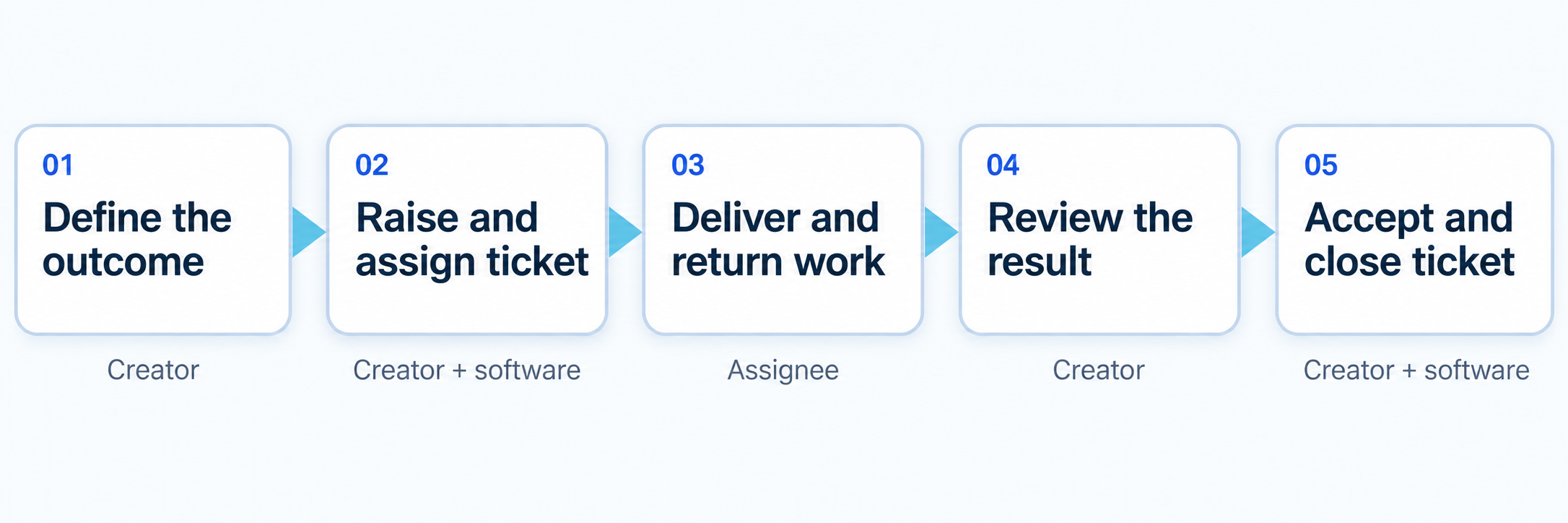
From a defined operational need to a creator-accepted outcome.
The operating principle
Raising a ticket is part of assigning work. The person receiving it delivers the result; the person who raised it remains responsible for final acceptance.
Evidence basis: implemented capabilities and owner-provided operating context. Business outcomes have not been quantified; this case does not claim measured savings or ROI.
02 THE OPERATING PROBLEM
The business workflow
The workflow starts when a person needs a defined operational result from another person or team. The creator supplies the request and timing, chooses an assignee and follows the work through to an acceptance decision. The result may be an analysis, a completed service action or a resolved operational issue.
Assignees carry out the work and surface questions or blockers. Viewers contribute context without taking ownership. Departmental managers oversee their teams’ work, while executives need visibility into demand, aging and cross-department dependencies.
The problem with the traditional workflow
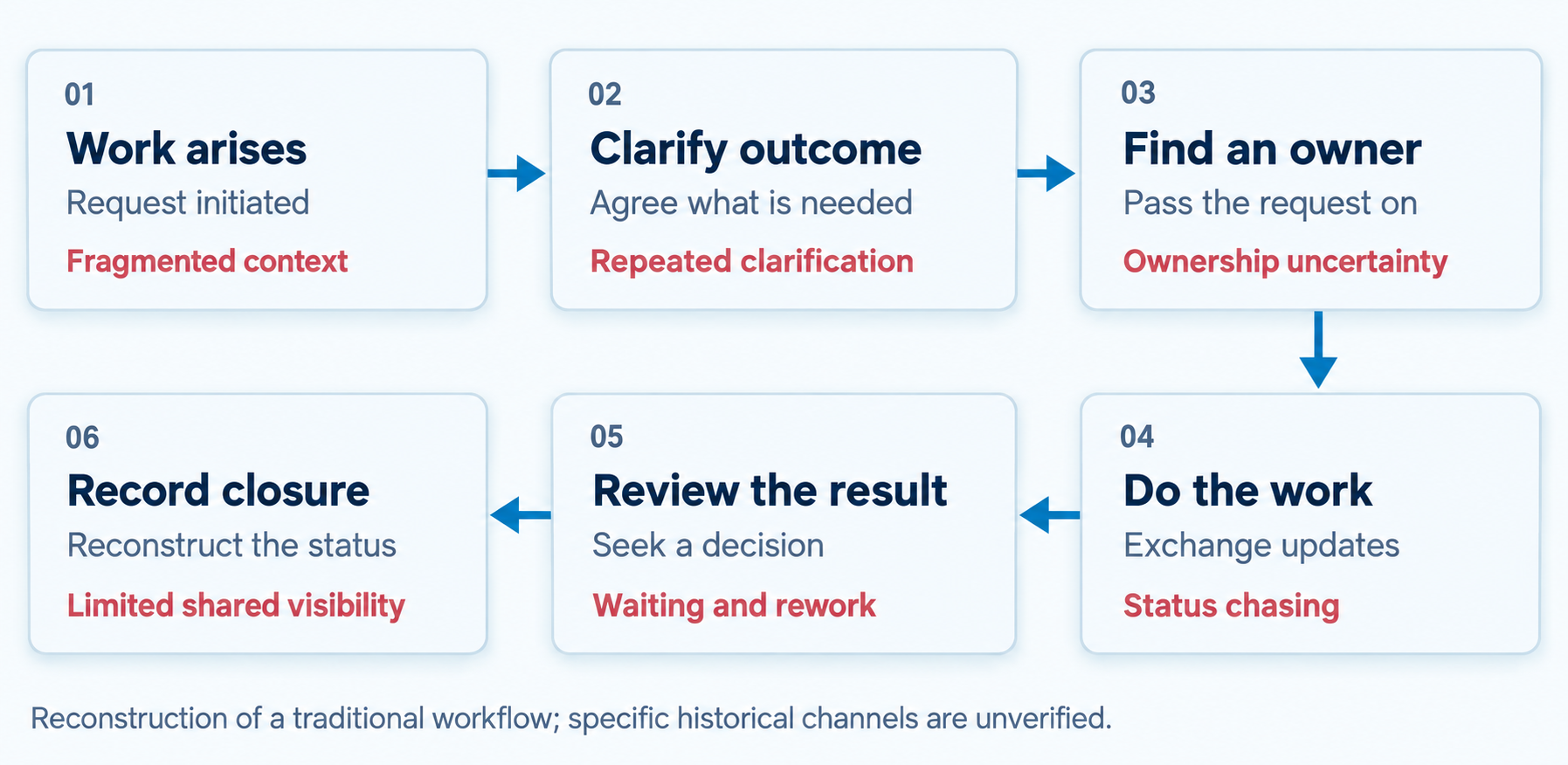
The six stages are held constant in the redesigned workflow on the next page.
Context and ownership
Scattered request details can require repeated clarification. Informal routing can leave the next accountable person uncertain, especially when work crosses a department boundary.
Follow-up and acceptance
Status chasing, waiting for review and reconstructing closure can consume coordination effort. A result may be delivered before it is explicitly accepted or recorded.
As assignments multiply, each unresolved question about scope, ownership or completion creates another coordination exchange. A shared workflow gives participants a common place to resolve these questions and gives managers a basis for directing attention.
Historical boundary: available evidence does not establish the company’s exact former process or tools. The diagram and pain points are design-informed inferences, not documented historical incidents or measured losses.
03 THE REDESIGNED WORKFLOW
The redesigned workflow
The company makes a ticket the operating record for an assignment. The creator defines the intended result, selects an owner and sets the deadline. Software places the ticket in the relevant queues and generates notifications; the assignee supplies progress, questions and delivery evidence.
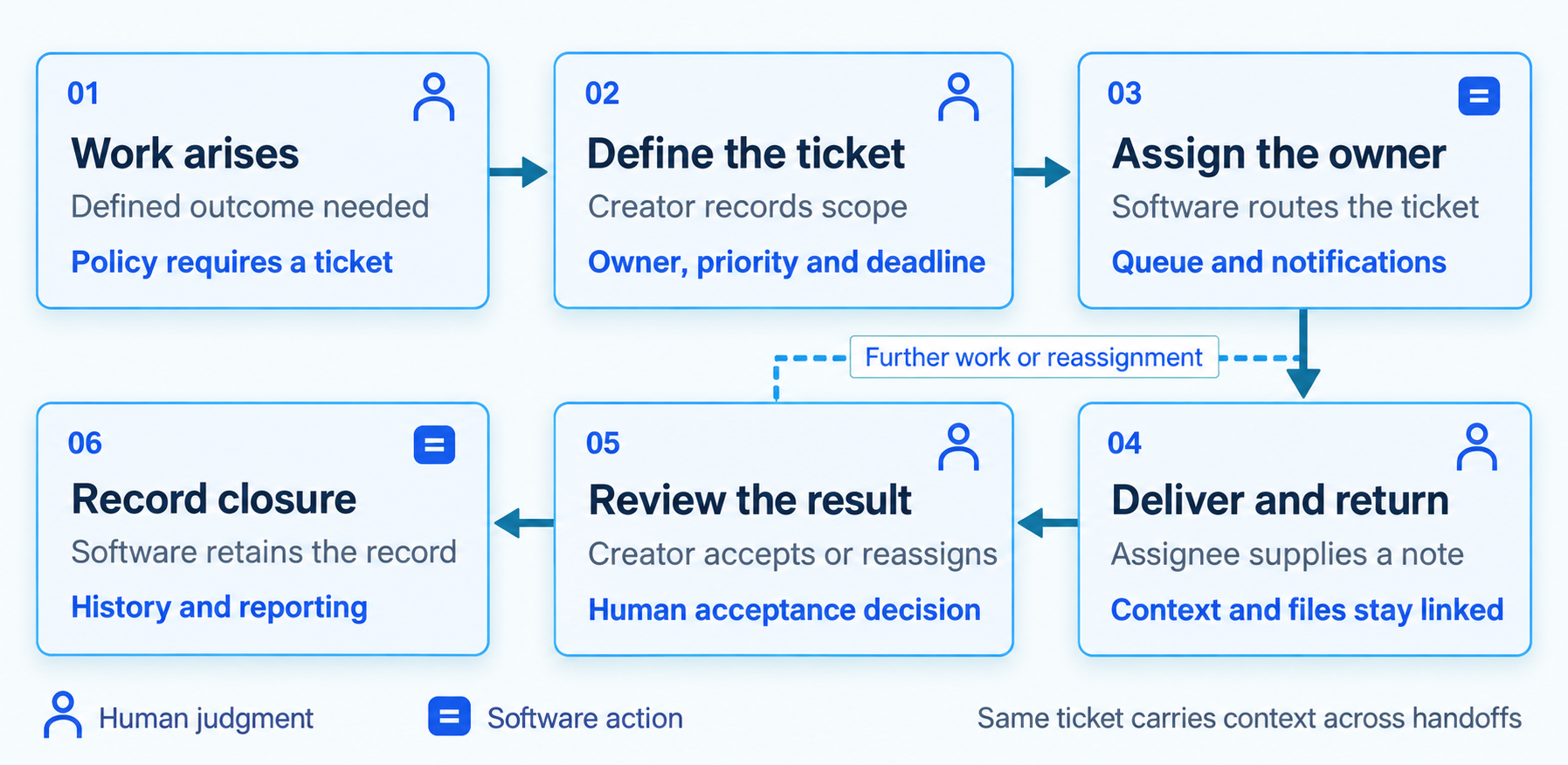
The same six stages now share a ticket record. Blue shows the redesigned path; the person icon marks human judgment.
What the application does
Capture and route work
Combines the request, selected owner, department, priority, deadline and files. Saved drafts support interrupted intake; dated recurring copies support repeat work.
Coordinate execution
Keeps discussion and updates beside the request. Personal, sent and shared queues give participants distinct views of the same work.
Make handoffs explicit
A return requires a note and can include files. Responsibility moves back to the creator, who completes, cancels or reassigns the ticket.
Surface exceptions and demand
Shows pending returns, stalled or on-hold work and deadline exposure. Department and executive views support review of backlog and interdepartmental demand.
When delivery needs intervention
An assignee can record a blocker in the ticket. The creator or an authorized manager can clarify the request, revise a deadline or reassign work. Pending-review and overdue views surface work that needs attention.
People define outcome quality. Return for review is the designed delivery path; the creator can also close an active ticket directly. Policy compliance outside the application is an organizational responsibility.
04 THE APPLICATION AND ITS CONTROLS
How the application works
The application encodes assignment and acceptance rules in one work record. People perform the operational work and judge its quality. System administrators maintain user access and role settings.
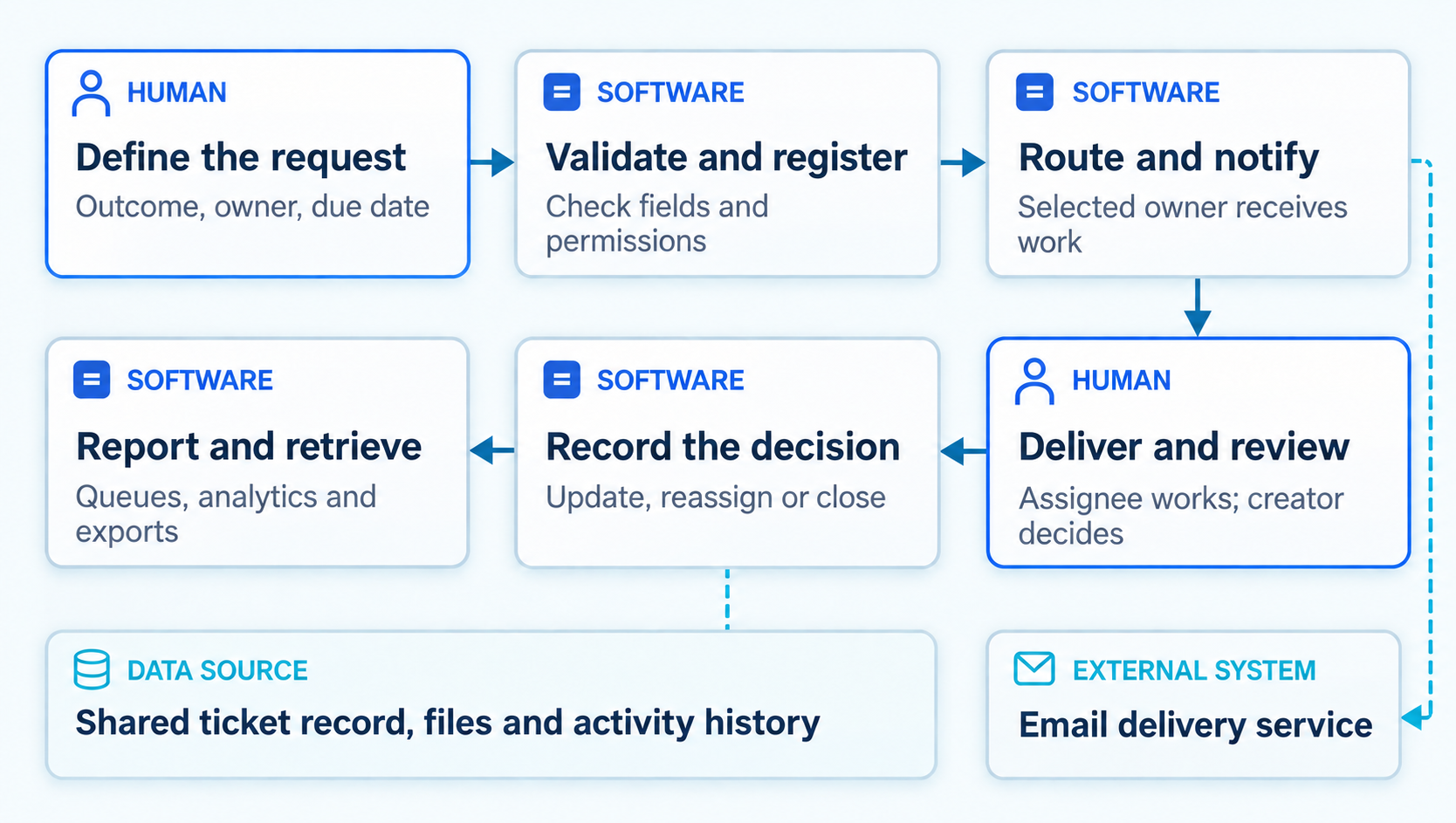
Human decisions, deterministic software, stored data and external email are distinct. No AI processing stage was identified.
Inputs and processing
Request text, people, dates and files enter through forms. Software checks form values and permissions, records the ticket and applies workflow rules.
Coordination and actions
Assignment changes update queues. Supported events generate in-app notifications and email; status, date and handoff changes create activity records.
Human control and outputs
People choose scope, owner and priority, handle blockers and accept results. The application retains the ticket, files, discussion and recorded decisions.
Visibility and AI
Users see work queues; managers see age, deadline and department reports with exports. No AI inference or autonomous decision-making was found in the application.
Automation boundaries
Internal deadline reminder logic exists, but its production schedule was not verified. A separate client-request module provides system-to-system ticket exchange and, when scheduled, reminders, daily summaries and automatic closure of long-unconfirmed resolved requests.
Internal operational escalation remains human-led. Completed and cancelled internal tickets lock operational edits; creators can still share the record with additional viewers. The client-request lifecycle has separate closure rules.
05 BUSINESS VALUE AND EVIDENCE
What changed
The implementation creates a common record for assigning, delivering and accepting work. Its strongest demonstrated value is the visibility and control built into that record. Wider productivity benefits remain potential outcomes to validate.
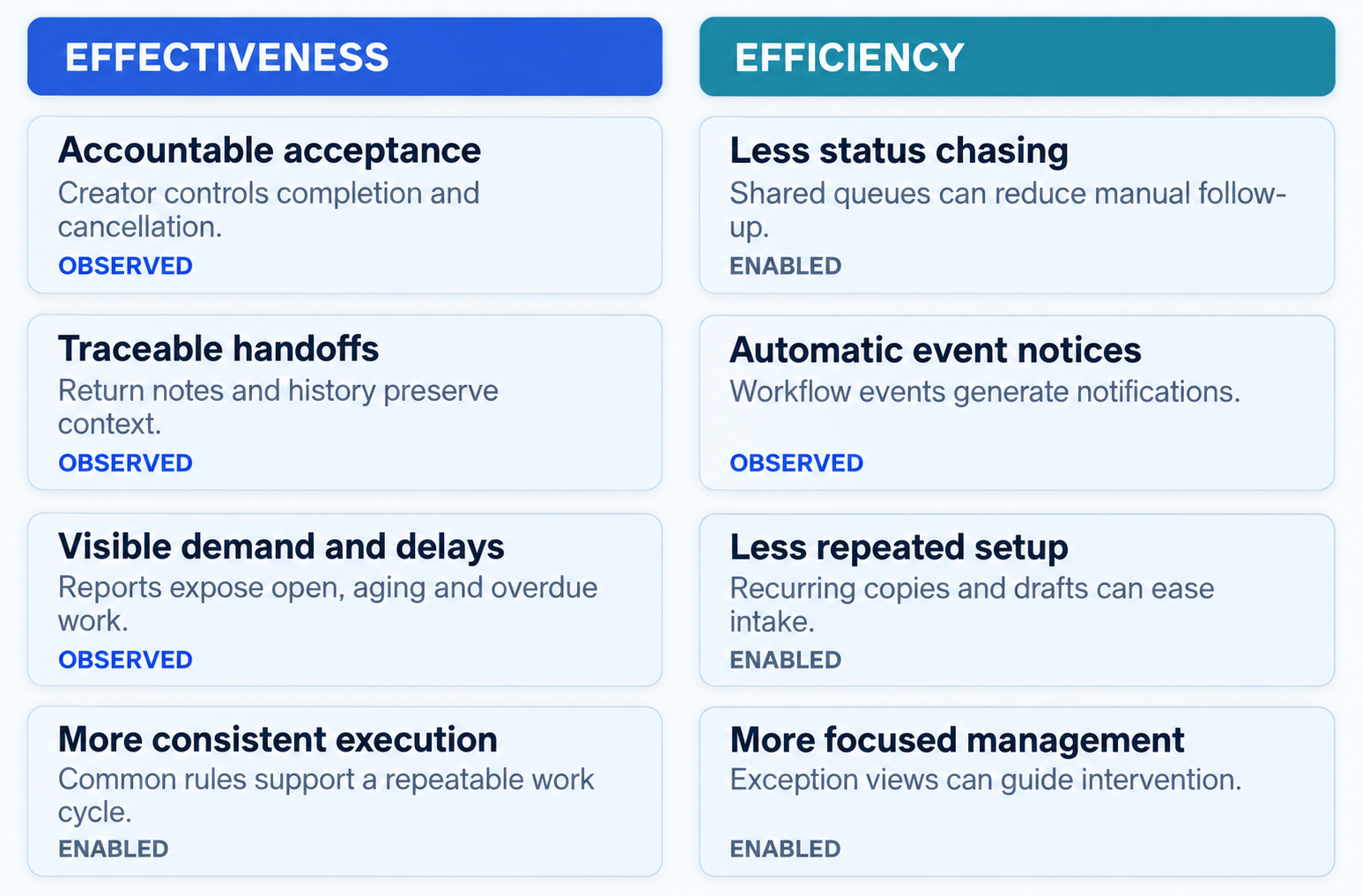
Observed means an implemented capability. Enabled means a supported potential benefit. Neither label implies a measured operational gain.
How to measure the next stage
Proposed measure | What it would establish |
|---|---|
Assignment to acceptance time | Whether work reaches an accepted outcome sooner. |
Time awaiting creator review | Whether acceptance becomes a bottleneck. |
Overdue work and coordination effort | Whether delivery reliability and follow-up effort improve. |
No quantified benefit dataset was available. Establish a baseline and comparable work categories before reporting improvement; no hours saved, cost reduction, productivity uplift or ROI is asserted here.
06 REUSABILITY
A reusable operating pattern
Any organization that assigns outcomes across people or functions faces the same questions: what is needed, who owns it, when is it due and who decides it is complete? A common work record connects those decisions without depending on physical proximity.
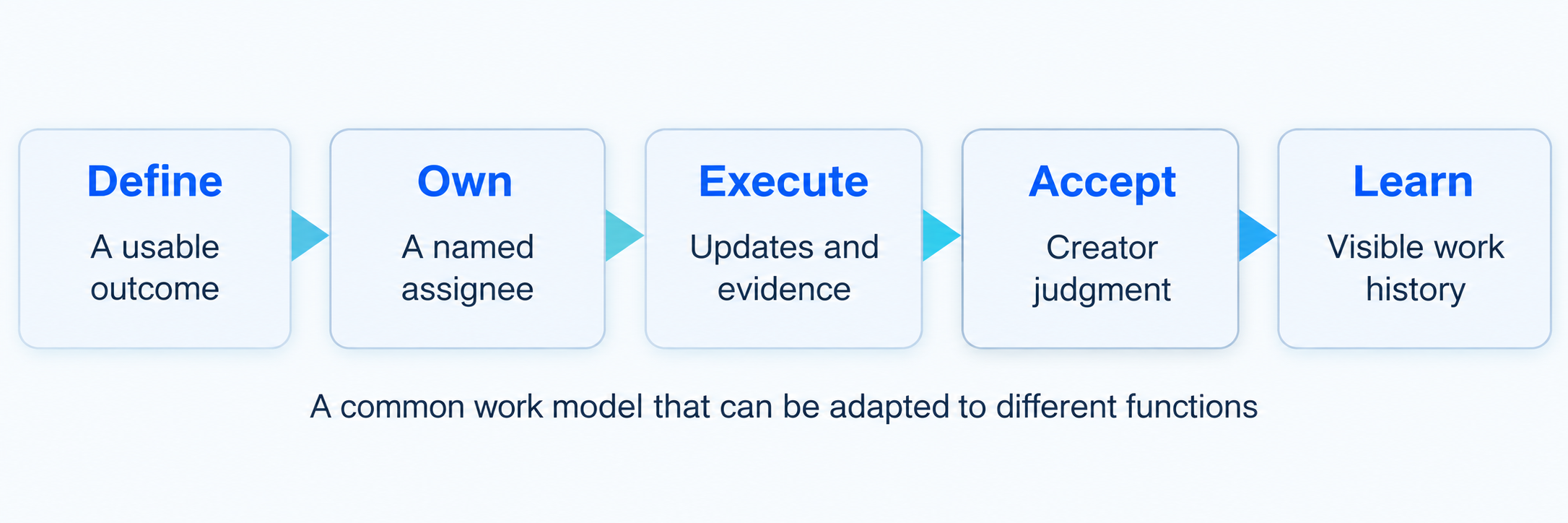
The transferable design is the assignment-to-acceptance cycle.
Where the pattern fits
Distributed organizations, professional-services firms and companies with frequent functional handoffs. Relevant uses include operations, engineering, service delivery, research, sales support and project coordination.
What can be reused
The ticket data model, creator–assignee relationship, return-for-review handoff, viewer participation, notification events, workflow history and department reporting structure.
What each organization must decide
Design choice | Customization required |
|---|---|
Assignment and acceptance | Ticket categories, outcome guidance, role boundaries and approval authority. |
Exceptions and communication | Deadline rules, reminder schedules, escalation owners and notification recipients. |
Data and management | Integrations, access controls, retention needs and measures of success. |
Purpose-built software allows these choices to follow the organization’s operating model: creator-owned acceptance, a visible return queue and reporting on work raised and received between departments. Adoption still requires clear briefs, current updates and managers who use the record to resolve exceptions.
What this case demonstrates
A virtual workforce can organize operational work around explicit commitments and accountable acceptance. The application connects the request, delivery evidence, human decision and management view, while automating routine recordkeeping and notifications. The transferable value comes from designing that complete work cycle and making it usable in everyday operations.
ANONYMIZED CASE STUDY