01 / EXECUTIVE SUMMARY
Connecting role requirements to evidence based candidate evaluation
An anonymized workflow transformation case study
A recruitment team needs a consistent way to turn a role brief and applicant submissions into a defensible pre-interview shortlist. This case covers two connected workflows within one purpose-built recruitment application: creating an assessment and evaluating an existing form.
Business challenge
Recruiters must interpret role requirements, assess resumes and practical work, reconcile incomplete evidence and brief interviewers. When these steps sit in separate documents, maintaining a common standard takes repeated manual effort.
Objective
Make role-specific screening repeatable and traceable while keeping the recruiter responsible for decisions.
Solution
A shared workspace connects role context, candidate evidence, AI-assisted evaluation and human review. It uses the native AI client installed on the computer, signed in through an existing subscription and connected over the internet, without a direct AI API integration or API-key billing.
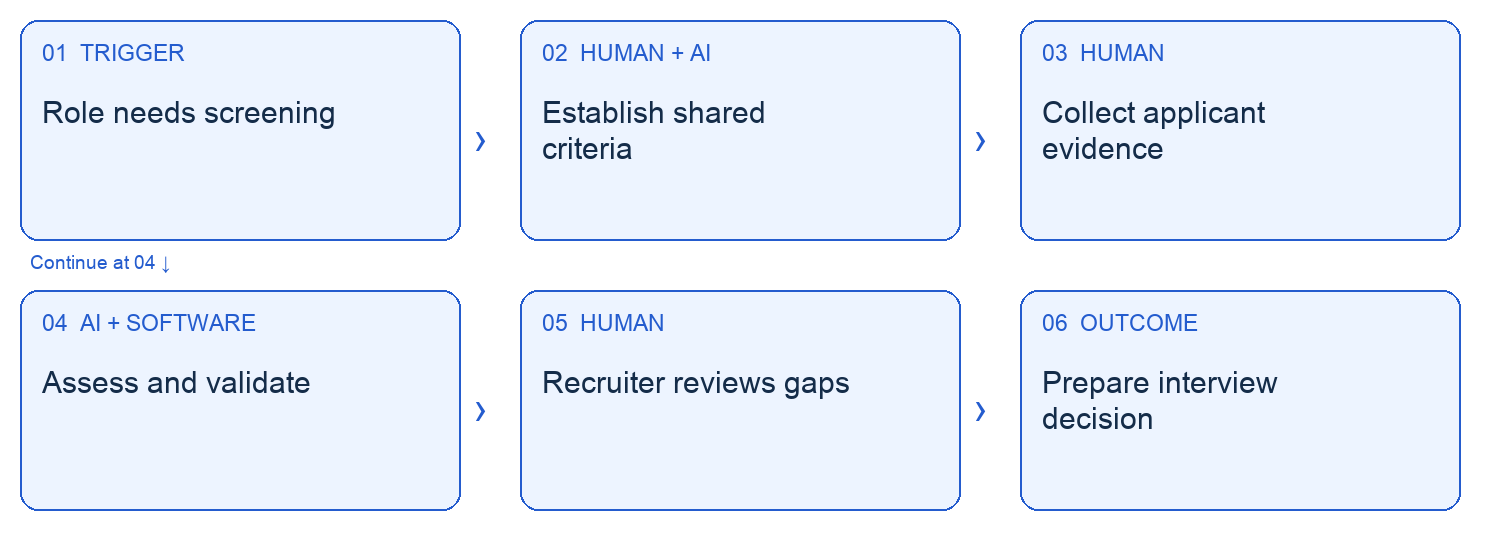
Business workflow at a glance
Value created
Implemented capabilities include reusable rubrics, source-linked scorecards, evidence coverage and batch rankings. These enable less repetitive administration and more focused interviews; operational savings have not been quantified.
02 / BUSINESS CONTEXT
The business workflow
From a hiring need to an interview handoff
The trigger is a role that needs screening, or an existing set of completed evaluations. A recruiter supplies the job description and any supporting brief, then establishes the assessment. Applicants provide resumes, answers and practical assignments where required. Recruiters review the resulting evidence and prepare technical and executive interviewers.
Before state reconstructed from the application design
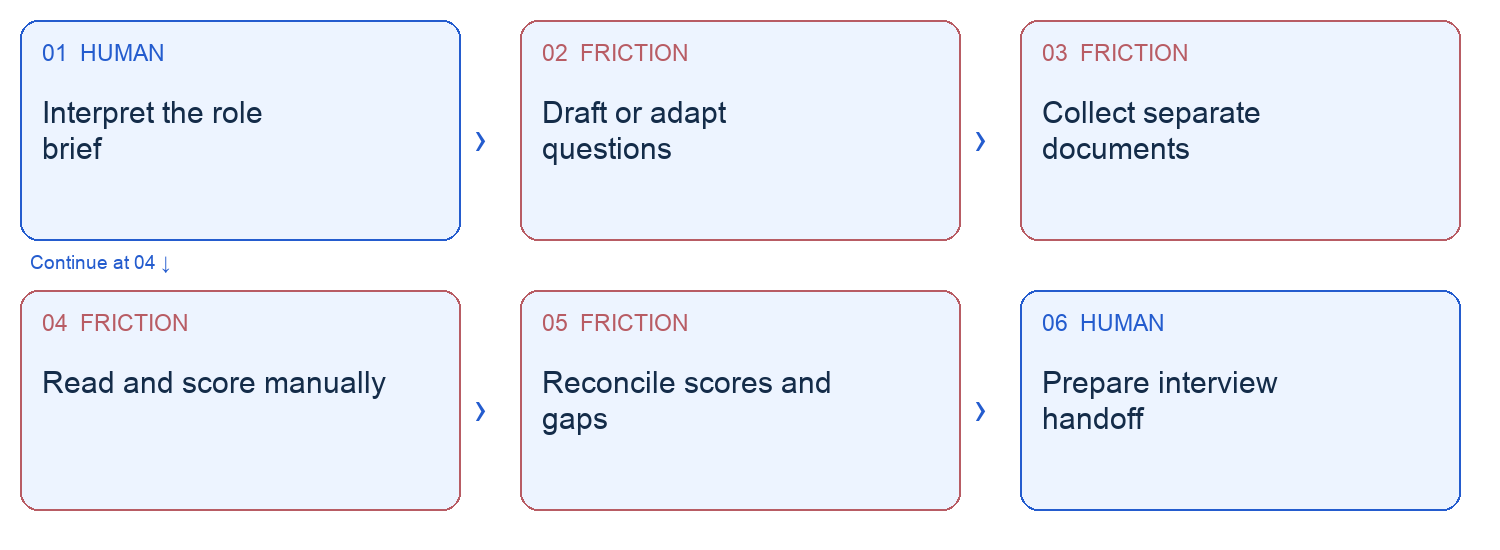
The problem with the traditional workflow
The before state is an inferred operating pattern, not a documented historical process. The application design addresses five recognizable sources of friction:
Repeated interpretation
Role requirements and scoring expectations can need to be reconstructed for each screening cycle.
Fragmented evidence
Resumes, answers and assignments can be reviewed separately, making contradictions harder to inspect.
Inconsistent comparisons
Changing criteria or comparing different questionnaire versions weakens the basis of a shortlist.
Hidden gaps and manual consolidation
A headline score can obscure missing essentials. Combining notes, totals and interview handoffs adds administrative work.
03 / WORKFLOW REDESIGN
The redesigned workflow
Two entry points with a common evaluation discipline
For new screening, AI drafts a role-specific assessment, requirement map, weights and private grading guidance. Generated questionnaires are designed for 20–30 minutes and include a practical exercise for technical roles. Alternatively, recruiters upload the form applicants already completed; AI derives and saves its shared rubric without candidate submissions influencing its construction.
After state with human decisions visible
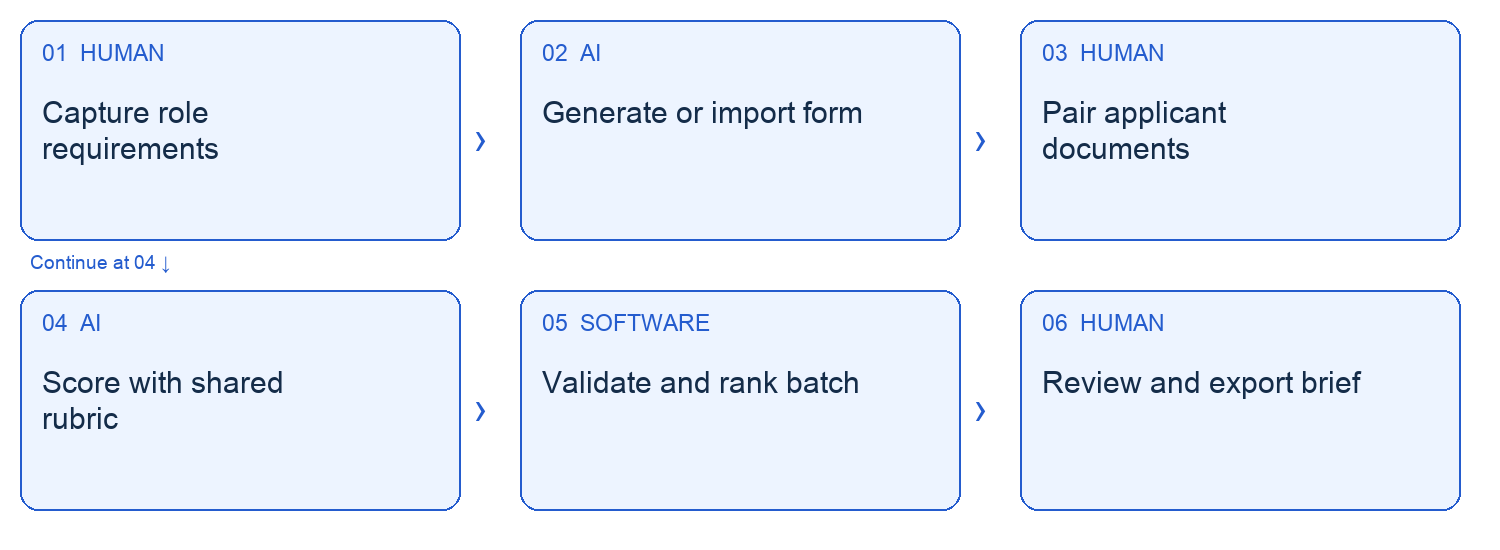
Capture and structure requirements
Role briefs and source documents become weighted, job-relevant criteria. Assumptions remain visible for recruiter review.
Collect and pair evidence
Applicant forms support reachable-network submission or offline completion. Recruiters pair each resume with answers and any required assignment, then review extracted text.
Evaluate consistently
The same saved rubric supports later batches. Evaluation batches contain up to five candidates who completed the same assessment version.
Support review and handoff
Rankings, evidence quotes, gaps and separate technical and executive interview notes support recruiter review. Decisions and notes are saved; candidate communication remains with the team.
04 / APPLICATION AND CONTROL
How the application works
Different responsibilities at each stage
A local recruitment workspace invokes the installed native AI client. Its internet connection supplies remote AI processing.
Application flow and responsibility map
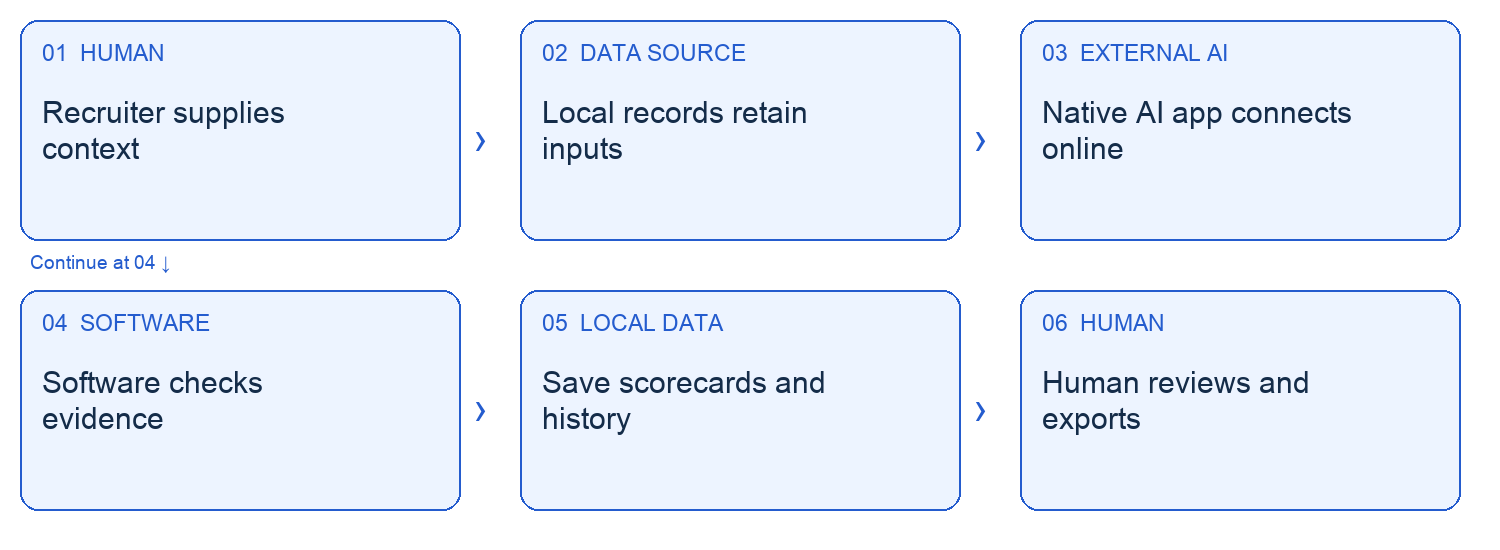
AI interprets and drafts
AI drafts assessments, rubrics, scores, gaps and interview notes. Submitted code is read as text, not executed or independently verified.
Software validates and calculates
Software checks outputs and matches quotes to each applicant document, then calculates weighted scores, coverage and ranks. Matching proves provenance, not the truth of a claim.
Cost conscious AI access without API integration
The application invokes the command-line interface supplied with the native AI app installed on the same computer, using its existing subscription sign-in. It uses no AI API SDK, API keys or separate API-key billing. The installed client connects over the internet for AI processing; account usage limits still apply. Reusing this access route is the cost-conscious design innovation, with no measured savings claimed.
Local records preserve continuity
Inputs, versions, scorecards and review history remain local. Ranking and role exports support recordkeeping; applicant forms exclude private grading guidance.
Humans control exceptions
Missing essentials force a hold. Failed jobs need manual retry with inputs retained. Recruiters resolve gaps and decide; hiring, messaging and external escalation are not automated.
05 / BUSINESS VALUE
What changed
Effectiveness and efficiency
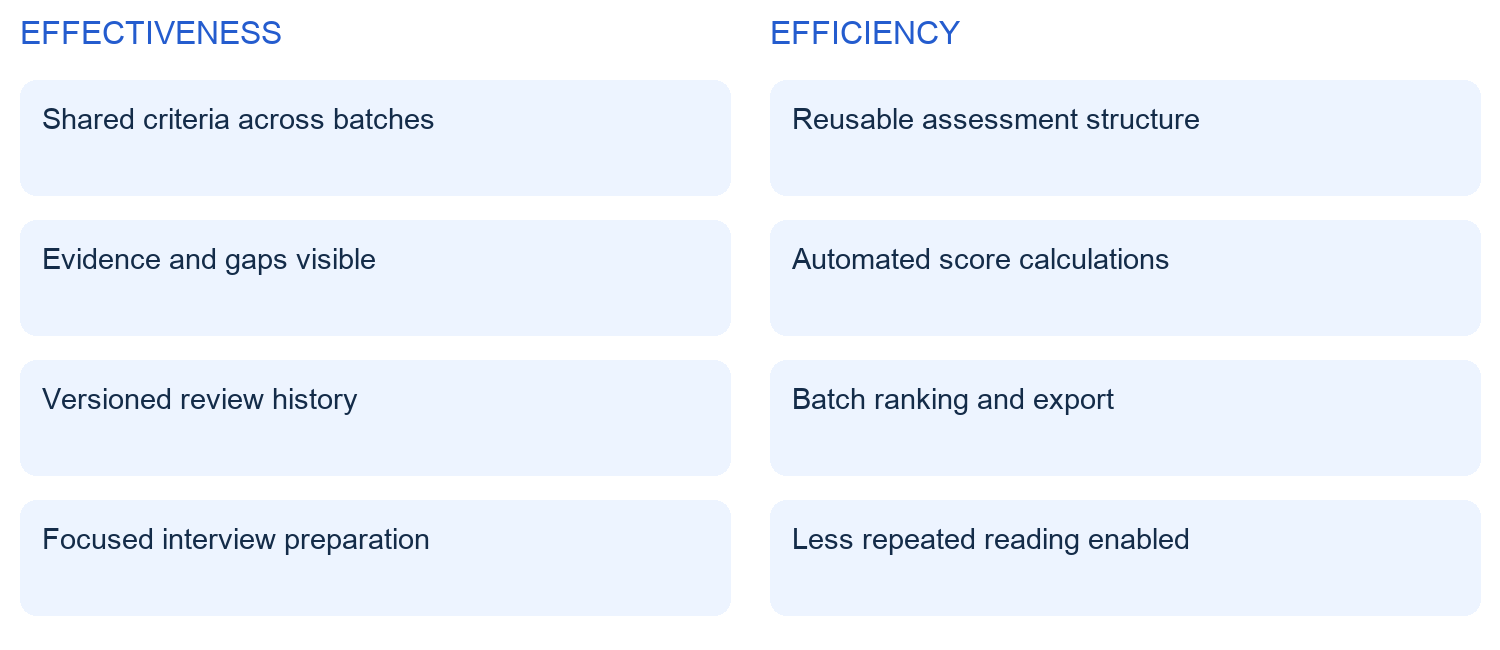
The design creates a more consistent basis for screening and automates repeatable processing. The value map separates decision support from administrative simplification.
Business value map
Observed capabilities
Shared scoring criteria, quote checks, visible evidence coverage, ranking snapshots and review history are directly represented in the implementation. Re-evaluation preserves prior results and resets the current review to pending.
Enabled operating benefits
Recruiters can reuse assessment structures, inspect evidence in one place and prepare interviews from structured briefs. This can reduce repeated reading, calculation and consolidation, and make handoffs more consistent.
Measures for an operating pilot
Track reviewer minutes per candidate, elapsed screening time, corrections to AI scores and frequency of unresolved evidence gaps. Compare like-for-like roles and retain human review of decision quality.
Evidence boundary
No measured productivity, cost, hiring-quality or fairness outcome is established. Rankings are advisory within a batch; they are not a validated prediction of job performance or a comparison across unrelated roles.
06 / REUSABILITY
A reusable operating pattern
A common screening problem
Recruitment teams repeatedly convert unstructured role descriptions and applicant work into comparable evidence. The same pattern is relevant to staffing businesses, professional-services firms and internal hiring teams that screen technical or non-technical roles.
What can be reused
The transferable design is a chain of explicit requirements, a stable rubric, separately retained evidence, validated structured outputs and recorded human review. Versioned assessments and batch snapshots preserve the basis on which each comparison was made.
A reusable cost conscious access pattern
Organizations with suitable native AI client access can explore the same subscription-backed approach before building a separately billed API integration. Feasibility depends on client capabilities, account access, usage limits and workload. The design avoids API-key billing; it does not establish that all AI use is free or cheaper for every organization.
What must be customized
Each organization needs its own role taxonomy, grading anchors, assignment standards, decision authorities and interview practices. Document formats, retention rules, evaluation metrics and integrations also need to fit its operating environment.
Deployment conditions
The current application is a trusted-network workspace without recruiter login, user-level permissions or HTTPS. Broader deployment requires those access controls. AI processing sends extracted text to a remote service. Applicant contact uses existing channels; no applicant tracking system or email integration is implemented.
Human accountability
Recruiters review criteria, assumptions, source pairings, scorecards and gaps. Interviewers verify capability, authorship and claims through their normal process. Hiring decisions and applicant communication remain human responsibilities.
What this case demonstrates
Purpose-built software can connect role definition, evidence collection, evaluation and interview preparation into a coherent workflow. Its value comes from a stable evaluation structure, automated repeatable checks and visible human judgment. AI contributes interpretation and draft analysis within that structure; the recruiter remains accountable for how the evidence is used.
EXECUTIVE CASE STUDY • RECRUITMENT