EXECUTIVE WORKFLOW TRANSFORMATION CASE STUDY
Connecting Clinic Activation and Daily Field Follow Through
An anonymized workflow-transformation case study
For a distributed clinic screening program, installation is only the beginning. Operations must know whether clinics are ready to follow the standard operating procedure (SOP), whether screening activity is being reported, and who will act when execution stalls.
Business challenge | Objective |
|---|---|
Clinic rosters, screening reports and field conversations describe different parts of the same job. Coordinating these inputs creates a recurring reconciliation problem as assignments, dates and outcomes change. | Create a shared daily process that connects ownership, visit commitments, verified readiness and follow-up, with enough detail for managers to intervene. |
Solution
A purpose-built operations workspace connects a managed clinic roster, scheduled screening-report imports, guided review calls, dated visit plans and follow-up actions. Rules validate new readiness confirmations and preserve the distinction between planned work and completed work.
Business workflow at a glance
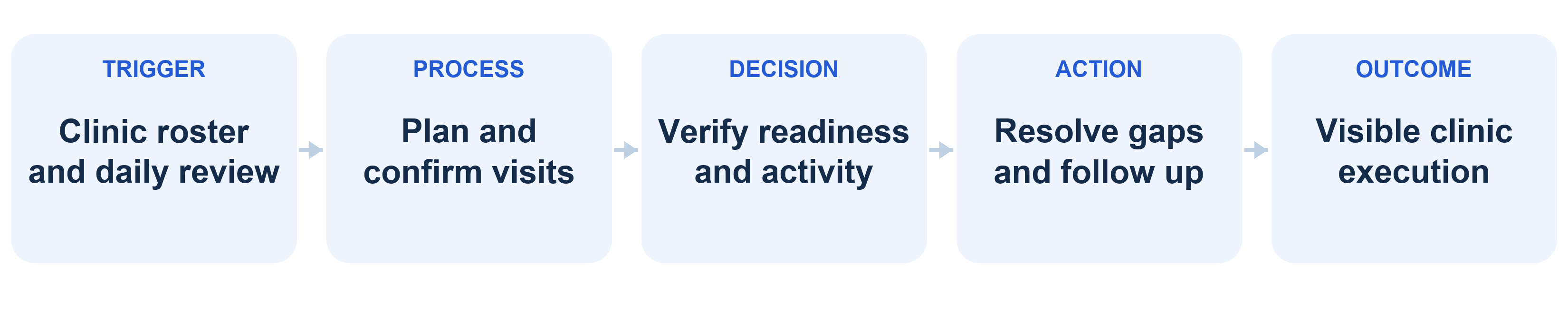
One daily operating loop connects field commitments with clinic execution.
Value created
• A shared view of clinic ownership, installation progress and activity.
• Explicit pending states and dated follow-ups for incomplete work.
• Preserved visit, call and installation-stage history.
• Less repetitive reconciliation is enabled by scheduled imports and batch updates.
Implemented capabilities are distinguished from potential operating benefits. No measured time savings, financial returns or clinical outcomes are asserted.
01 / THE COORDINATION PROBLEM
The business workflow
The process starts when a clinic enters or changes in the roster, an activation visit is due, or the daily review begins. Operations staff coordinate with field representatives, who report to area managers and visit clinics. Doctors and reception staff carry out the underlying screening process; their activity reaches a separate reporting portal.
Operations needs to connect contacts and ownership with installation dates, readiness evidence, screening counts and field feedback. Each review leads to a decision: confirm a plan, record an outcome, investigate inactivity, resolve missing information or set the next action. Managers need visibility across this loop.
The problem with the traditional workflow
The following before-state is an evidence-backed reconstruction. A roster spreadsheet, separate reporting source and human review calls are documented; the exact former process and its performance are not.
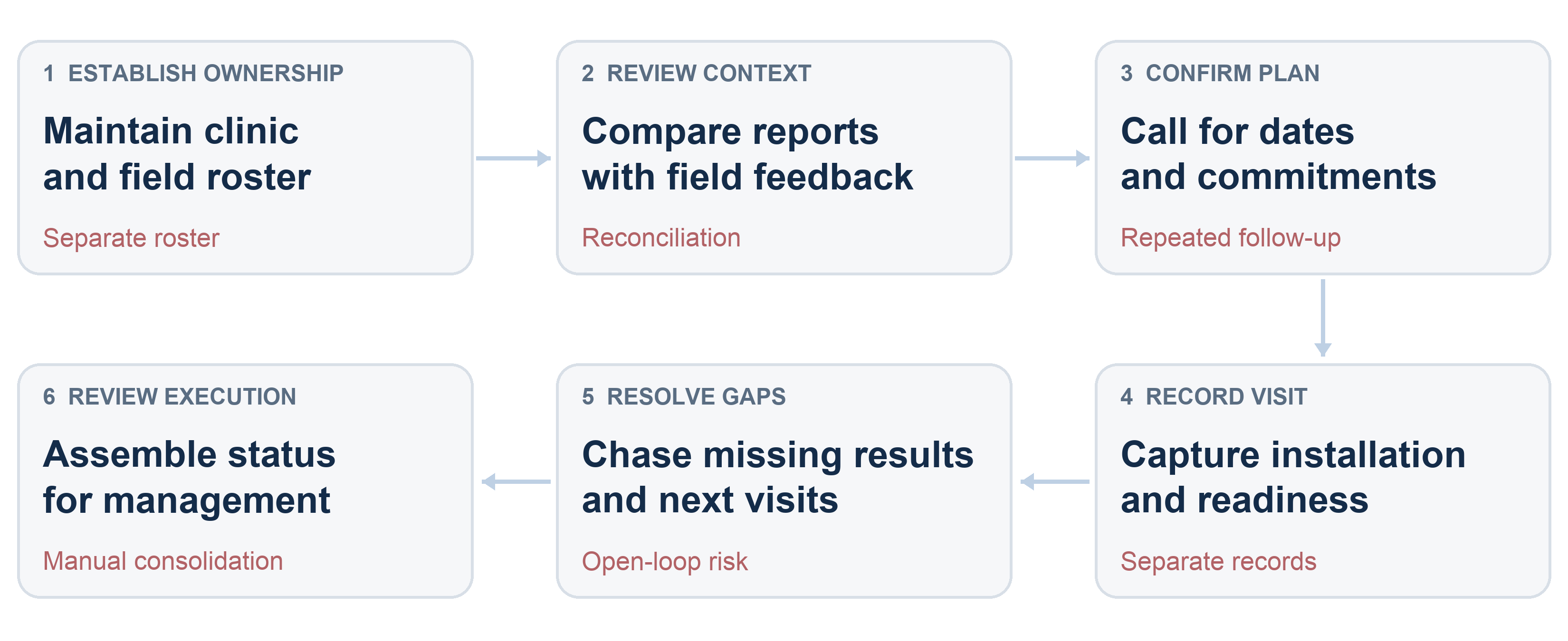
Before-state reconstruction. Muted red labels identify potential friction, not measured failures.
Coordination challenge | Why it matters |
|---|---|
Separate versions of the work | Roster, report and conversation can reflect different dates or owners. |
Readiness confused with activity | An installed clinic may not follow the procedure; an inactive clinic may instead lack valid reporting. |
Changing dates obscure commitments | Rescheduling and later completion can make earlier confirmations difficult to reconstruct. |
Follow-up depends on reconciliation | Without connected records, people must bring outcomes, next visits and overdue work together. |
These are recurring coordination pressures. As a clinic network grows, the number of relationships and exceptions can increase the work needed to maintain a dependable management view.
02 / ONE SHARED OPERATING LOOP
The redesigned workflow
The application gives operations a shared record for each clinic and its assigned field representative. Managers establish the roster; operations reviews screening context, confirms visits through human calls and records outcomes. Incomplete work returns to a dated follow-up path, while managers can inspect the underlying clinic detail.
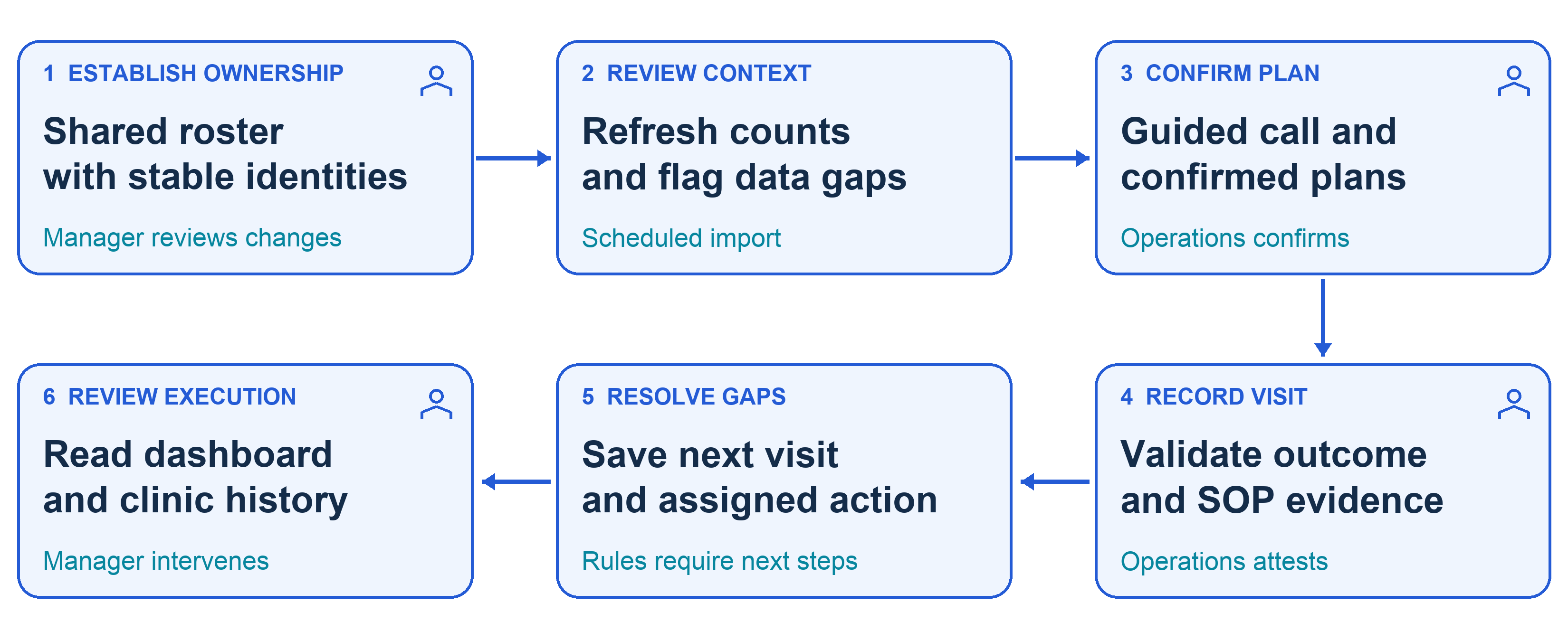
The same six stages now share records and rules. The person symbol marks human judgment.
What the application does
Business capability | Role in daily execution |
|---|---|
Maintain ownership | Stable staff identities, contact details and clinic assignments connect the work to an owner. |
Establish reporting context | Scheduled imports provide aggregate counts, source coverage and unresolved identity matches. |
Standardize review calls | Morning and evening checklists record confirmed, pending or not-applicable responses. |
Protect readiness decisions | New SOP confirmations require valid dates, doctor briefing and sufficient screening evidence. |
Carry exceptions forward | Rescheduling records a reason; incomplete or missed visits require a later visit; actions have due dates. |
Make execution visible | Managers inspect call coverage, installation stages, activity, categories, history and overdue actions. |
Operations still makes calls and chooses corrective actions. The application records and validates the work; dashboards surface exceptions for human intervention.
03 / AUTOMATION WITH HUMAN CONTROL
How the application works
People supply the roster, field updates and decisions. When configured, a server-side connection refreshes screening reports from an existing portal at startup and hourly. The application combines this operational context in one database and applies explicit rules.
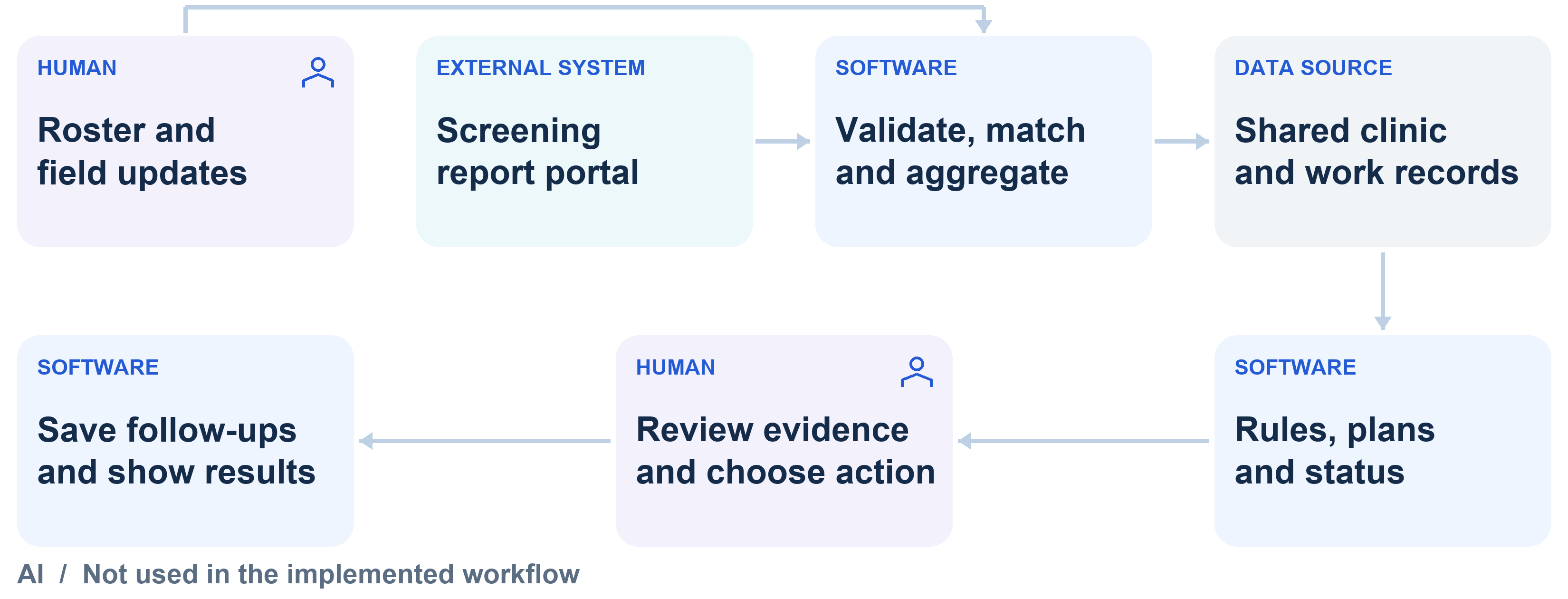
Information flow. Roster and report inputs converge in shared records; later steps repeat as new feedback arrives.
Element | What happens |
|---|---|
Inputs and processing | Managers preview roster replacements. Imports validate report freshness and completeness, match identities and retain clinic/day aggregates. |
Coordination and actions | Authorized saves update plans, outcomes, call reviews and actions. Invalid or conflicting batch changes are rejected together; retries avoid duplication. |
Human control | Operations attests field outcomes and evidence. Managers resolve ambiguous identities and approve roster replacement. Administrators control user access. |
Outputs and visibility | The workspace shows owners, contacts, dated stages, activity, reporting gaps, follow-ups and audit history, with register exports. |
Rules that protect the operating picture
New SOP confirmations require installation, a doctor briefing and at least two verified form fills between installation and confirmation. Imported legacy SOP flags can remain as manager-confirmed baselines without reconstructing missing historical evidence.
Activity uses the previous calendar day. Missing or stale reporting remains unknown; a verified zero can indicate inactivity. Failed imports retain the last cache and expose an error. Managers handle these exceptions; automatic outbound escalation is not implemented.
AI is not used in the implemented workflow. Scheduled imports, matching, validation and dashboards use deterministic software. Calls, physical execution and operational judgment remain human responsibilities.
04 / BUSINESS VALUE
What changed
The implemented change is a connected operating model: a clinic plan can be reviewed against reported activity, updated with field feedback and carried into follow-up without losing the earlier record. This creates two kinds of value.
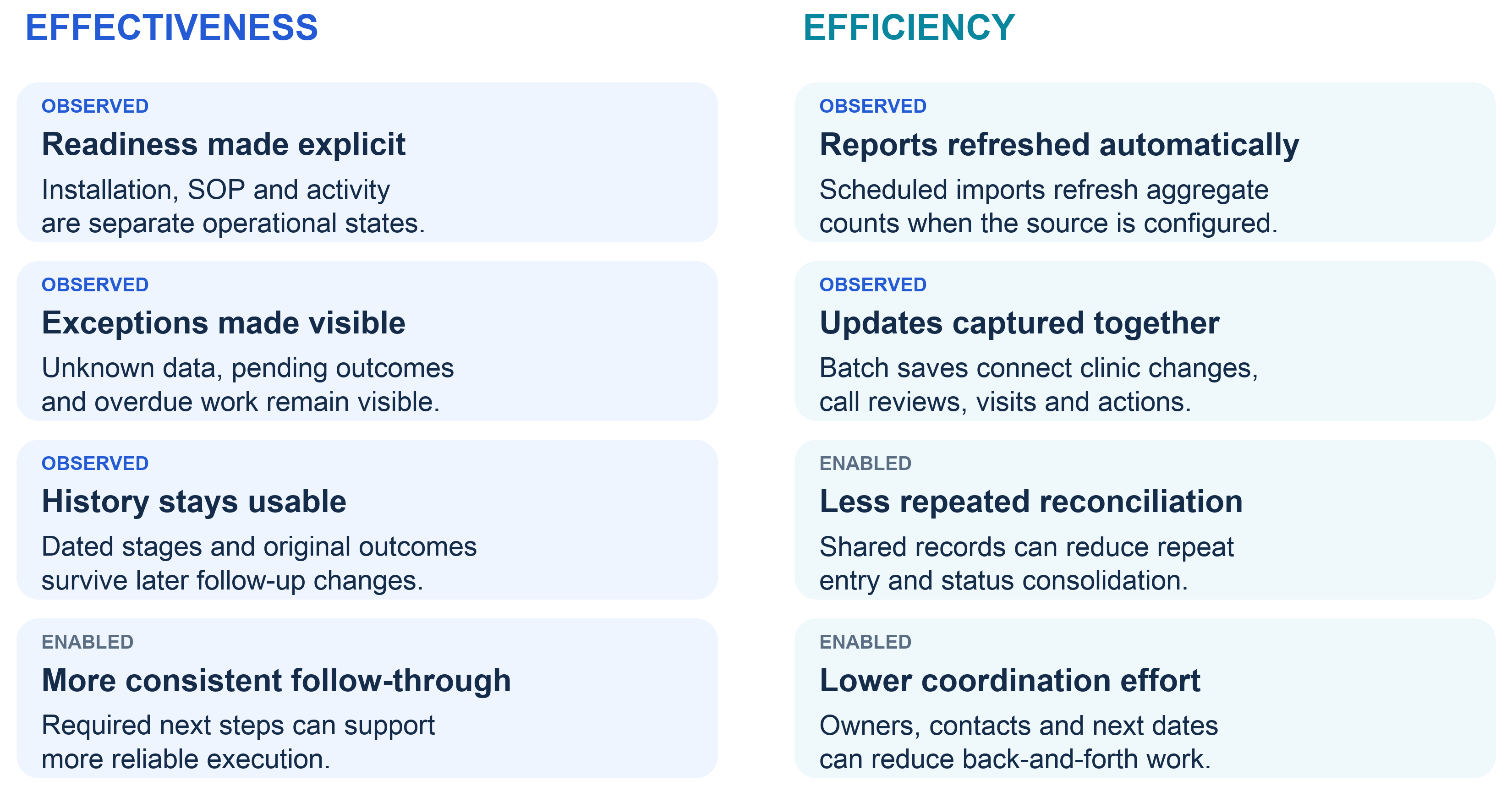
Observed means implemented capability. Enabled means potential benefit without measured impact.
Interpreting the management view
An installation date has separate prior-day confirmation, same-day reconfirmation and recorded outcome stages. A plan is not a confirmation. Later SOP completion preserves the original installation result. Known imported completions without reconfirmation are identified separately, so planned and installed totals need not match.
What is established and what needs measurement
The code demonstrates shared records, scheduled imports, explicit exceptions and controlled updates. The extent to which these improve speed, workload or execution depends on adoption and data quality. No before-and-after business measurement is available.
A practical evaluation would track review preparation time, reporting coverage, unresolved outcomes, overdue actions and follow-up completion. Targets and baselines would need to be agreed before claiming improvement.
05 / WHERE THE DESIGN CAN TRAVEL
A reusable operating pattern
The transferable problem is coordinating a distributed service network when a completed setup does not guarantee continuing use. Organizations need to connect ownership, scheduled work, evidence of readiness, actual activity and the next intervention.
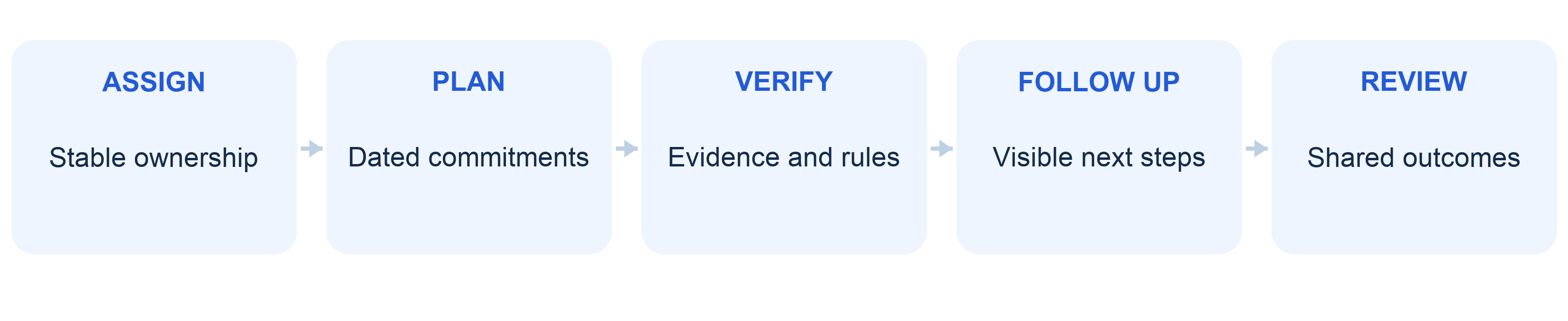
A repeatable pattern for coordinating field execution and exception handling.
Where the pattern applies
Relevant functions include field operations, program operations, area management, implementation teams and service support. Similar needs arise in clinic networks, distributed service providers and organizations rolling out services through many local locations. Clinical rules would require their own review before reuse.
Reusable design | What another organization would customize |
|---|---|
One location and owner record | Location structure, staff identity, territory hierarchy and contact data. |
Separate plan, confirmation and outcome | Commitment stages, visit timing, evidence rules and completion criteria. |
Explicit unknowns and follow-up paths | Source freshness, issue categories, responsibility, deadlines and escalation policy. |
Shared history and management drill-down | Reporting measures, retention, access rights, privacy requirements and integrations. |
What makes adoption work
The organization must define who maintains the roster, who verifies evidence and who resolves reporting gaps. Integration monitoring and reliable source data are continuing responsibilities. The current implementation uses a single application instance; broader deployment scale would need separate capacity and architecture assessment.
What this case demonstrates
Purpose-built software can turn recurring field coordination into a visible, governed workflow. The value comes from connecting commitments, evidence and next actions in shared records, automating repeatable information handling and retaining human responsibility for calls, verification and exception decisions. The reusable asset is the operating pattern; its business impact must be measured in use.
ANONYMIZED CASE STUDY /